2012/06/29
Sword Lords (1981)
An old-school fantasy rpg-influenced Wargame. Rules for battles, ship combat, magic and dungeoneering. Lots of Random Tables.Lots of great old school artwork throughout.
"A game of fantasy armies, heroes, and adventures."
"The ancient stories of elves and men tell much about the titanic struggles of good and evil, but little has been recalled of those who were not of Middle Earth but of its fringes. With this book you may recreate a part of the Eastern Regions, the vast and diverse archipelago that bordered the eastern coast of middle earth, to sail between strange islands, face demons and gather treasure, and to fight large battles between the many powerful contenders for this part of the world long past."
DOWNLOAD HERE.
2012/02/19
Monsters! Monsters! (1976)

Can't believe my eyes, again. This is a real piece of fantasy rpg history. Enjoy!
http://rdushay.home.mindspring.com/Museum/Fantasy/Monstersrevw.html
2012/02/01
Dragonraid !! (1984)
I can't believe i finally found this.
I have been looking for it for a long time..
First of all, go see these three links:
link1
link2
link3
The magic system is incredibly interesting - i am aware that many persons out there are going to shun this, because it is linked with a strong religious theme. But we have to strive to consider it regardless of that (if possible). It is a very old school fantasy rpg, which was published for the first time in 1984 and -don't know why- it always exerted an influence upon me, maybe because it is so weird in its conception? Possibly so, in fact i believe it is unique in its approach, blending together "sword & sorcery" and religion.
For the first time, now i have the chance to read it,filling this gap in my background.
2012/01/31
Fantasy role play made easy (1985)

To me, this is one of the most sought-after item ever, but i'll probably never get a chance to read it in my entire lifetime, due to its rarity.
FRP made easy was a self-published book more than 200 pages long which attempted to improve the 1st edition of the AD&D game and was a complete system in one volume.
I don't have any hints at what its actual contents were, i can only guess, but i find myself daydreaming every day about it.
In what could an "improvement" of AD&D consist of back in 1985? Streamlining of the rules, or maybe a complete re-writing of them? (in order to make them easier,as the title seems to suggest).
And who used this instead of AD&D at that time? From a purely historical point of view (and for historical values as well) such questions are worth pondering.
I would love so much to be able to peruse the rules of this fantasy rpg, and see with my own eyes this different interpretation of what AD&D should have been like, in the intentions of FRP made easy's authors.
2012/01/30
Vikings & Valkyrs (1985) by Laurence Gillespie
Advanced Phantasm Adventures (1988)

I'm always perplexed at how people forget rpg's from the past, the nigh impenetrable indifference that surrounds fantasy rpg's which are part of the hobby's history.
Honestly, i should say that i was used to being puzzled by this phenomenon, but now no more.
I take it for granted, and as years pass, i become more and more aware that the OSR has been a new infatuation of Dungeons & Dragons and absolutely no more than that (except for Grognardia website, which celebrates regularly many retrospectives of other games, and in so doing it provides an invaluable plethora of information for everyone and for the future generations as well).
So, to reiterate this, we have to add another forgotten fantasy rpg called "Advanced Phantasm adventures", and i bet only a few among us noticed that a totally new site emerged recently, entirely devoted to this old-school (horror?) fantasy rpg originally published in Japan in 1988 by Dai Nippon Kaiga company.
From the creator's website:
The first edition of the game started out as an alternative to my Dungeons & Dragons game way back in high school. The game was original, fun, and rich in new ideas and rules. The year was 1982. The game saw its next genesis In 1987 when I had the wonderful opportunity to live and go to school in Japan. During that year I decided to rewrite Phantasm Adventures, into Phantasm Adventures II (2nd Edition). The game also saw print in Japan, after meeting up with some gamers who led me to a Japanese game company.
check the entire story here.
Grab the 4th edition copy of the actual game here:
http://depositfiles.com/files/0ecaupryi
Other links of interest, here, here.
And for the curious ones, there is a review of the game in Dragon magazine issue 193, where the author praises in particular the magic system of the game.
2012/01/29
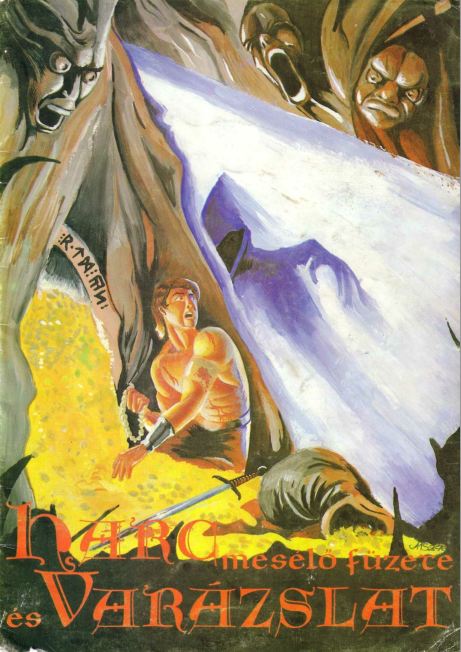
Harc es Varazslat (1991)
Ok, this evening a friend of mine gave me this fantasy rpg which i never saw in my life.
I don't have the slightest idea what it is, but it seems to be and old-school fantasy game. I can't even recognize the language in which it is written, it seems to me to be Czech or Slovak language, but i may be wrong.
I would like so much to be able to read and decipher it, but at present that is beyond my capacity.
Alas, a gate barring knowledge!
It contains several art pieces which depict scenes taken from Tolkien's work, and as far as i can tell this is not the rulebook but instead a sort of supplement detailing magic or something similar.
When you think you don't have many gaps in your understanding of the hobby, something suddenly pops up to remind you to be humble. So thanks to this game who showed my inability today.
It'd be interesting to hear from some fellow gamer of the country where this was published, how this game was like, its history, and any piece of valuable information.
EDIT: whilst writing this post, i stumbled upon this where a guy wrote the following:
There are some hungarian RPG-s as well:
Our very first RPG was Harc és Varázslat (Fight & Sorcery). Only the core game was released, and it was unfortunately not a big success, but its nevertheless one of my favorites. It used ten sided dice, and it was based on a percentile system. In feel it was similar to 1st ed AD&D, but simpler.
2012/01/20
Fantasy gamer's compendium (1983)

This is a fantasy rpg i know nothing about, i must admit it. I don't know why, it skipped under my radar, always.
Nonetheless, i suspect there is something interesting in it, particularly in "The Book of Sorcery" (Fantasy gamer's compendium is in fact composed of several books joined together).So this fantasy rpg eluded me, and i do want to know more of it, and it is likely i will buy it in the near future. I dislike the idea of a FRPG lying in the oblivion, because who knows what lurks beneath its surface?
If i am not wrong, the book of sorcery should contain not only spells but an entirely different magic system as well, which makes it all the more interesting, at least to me who have always been dissatisfied with that found in AD&D.
It is an OLD school fantasy rpg, no doubt about it (1983), and i would love to hear someone who actually played it or owns it.
On Dragonsfoot forum they don't know anything.
Other links: here, here and here, here, and some impressions here
2012/01/18
Miekka ja Magia (Sword & Magic) - 1987

I would love to hear someone who has ever played this fantasy rpg.
Translated automatically with Google from finnish language:
"Sword and Magic is a role to play adventure game where you and your friends can experience the breathtakingexcitement in underground caves and caverns dark adventure. Task is to find missing for centuries been the secret of gold-Aare, which is guarded by terrible monsters and mysterious spells using the Wizards. During the adventure you have to MonLineIn exciting life-threatening situations and fights. Vampires, snakes, gnomes, orcs and dragons are hungry for your blood, and only quick solutions, the exact sword attacks, and the controlled use of magic may beleading you into destiny."
Much information can be found here.
2012/01/17
Why no one talks about Ysgarth?
For the moment, i will just paste a description taken from the web, together with an old review of this old fantasy RPG:Ysgarth is a fantasy role-playing game written by David Nalle with contributions from other authors. It was originally released in 1979 by Ragnarok Games. The company also published subsequent editions of the game throughout the 1980s and 1990s, but no new edition has seen print since the 6th edition in 1995, although various revisions and addenda are available on the internet, including partial versions of an unpublished 7th edition of the game. Ragnarok Games also published a number of other board and roleplaying games during the period when Ysgarth was in print, as well as a games magazine called Abyss Quarterly. Many of those involved in the development of Ysgarth were also subsequently involved in the development of the Quest for the Grail Arthurian CCG published by Stone Ring Games.
Ysgarth is generally noted, both positively and negatively for the extreme detail of its game mechanics. It was one of the first roleplaying systems to rely heavily on skills and discard the idea of character classes and also one of the first games to rely solely on the use of 10 sided dice for percentile rolls in resolving actions. Ysgarth also emphasizes realistic combat resolvable in minute detail. Some have praised the mechanics as innovative and others have damned them as cumbersome. This issue of excessive mechanics is made more complex by the fact that each edition of Ysgarth featured fairly radical changes in the implementation of the basic rule concepts varying in their level of complexity. The 5th edition actually included three completely different versions of the mechanics in a single rulebook.

2012/01/16
The enthralling mystery of Bifrost

Today i was thrilled when in my blogroll i noticed that Randall on Retroroleplaying blog wrote a post about an obscure fantasy RPG which matters a lot to me. My eyes immediately fell on the title of the post and i was excited in reading what he had to say. Basically he was asking any kind of information which might be available about Bifrost, which- for the american audience- is probably one of the most difficult fantasy rpg to obtain, because it was released in the UK and from what i understand it didn't get much notoriety outside of the UK and Europe.
I've been chasing Bifrost for a long time because i instinctively felt there was something special about it, and i was not wrong nor was i disappointed once i managed to get my hands on it. I don't want to repeat here what i already wrote as a comment today on Randall's blog, suffice it to say that i consider Bifrost a beautiful gem, and one of the best fantasy rpg of all time.
I would be very happy to contribute in this sense to the OSR community trying to spread the knowledge of this game. I was already trying something similar with Melanda and other obscure fantasy rpg which i deem deserve more attention. Those who read my blog already know that my attitude is more centered towards other fantasy rpg other than Dungeons & Dragons, so it is not surprising if i add Bifrost to the already existing list.
To begin with, i think a good idea is to highlight, the only (as far as i know) review that was ever written about Bifrost. It appeared in White Dwarf magazine issue 7, was penned by Don Turnbull and it shed some light on this fantasy rpg though i don't agree with everything written therein. Without further ado:

2012/01/10
Melanda, land of mystery - and its enchanting modules

Another glimpse into Melanda: someone asked for it, and here it is.
After all, someone has to talk about this obscure object of desire. This is- as far as i know, the only existing review about Melanda, it appeared in Different worlds magazine many, many years ago.

It is interesting to note that Wilmark dynasty apparently published some of the most astounding adventures ever-they are sought after by several collectors since they are hard to find.
"The Wilmark Dynasty published 6 adventures for Dungeons and Dragon (or they could also be used in the Wilmark Dynasty's original role-playing game : MELANDA). Each received critical acclaim for the concepts and depth of roleplaying. The modules are not up to today’s standards as far as artistry and presentation which is amateurish at best. However the modules have been widely lauded for their uniqueness of design and the cleverness of their challenges. All in all a module which is an absolute must for the serious collector!" -- from Days of Knights auction webpage.
have a look here.

It is interesting to note that all of the the Days of Knights auction webpage's claim that 500 of each title were printed with a claim that fewer than 100 survive. This could be bold speculation or an insider's perspective. It does differ from the claims made in the interview provided within this site. Alas that period in time was more than 25 years ago. Sometimes details can be muddied over time. It is up to us to draw our own conclusion based on the information available to us. (text taken from TOT website)
As an example, we have the lejendary "Burgundy pit" (which i would REALLY love to play someday...):
The Burgundy Pit is a scenerio in a Wizards stronghold to retrieve a magical crown. "This module originally run as the final for a D&D tournament at Penn Con in 1978. The module has a legend concerning it. According to its author, he has run it over a dozen times and no individual who entered ever lived to tell the tale. So it is not only a very special addition to any Dungeons & Dragons collection but it is also a rare find for those players who are sure they can conquer any enemy. However, beware, might does not conquer all in this fascinating adventure! Characters must cooperate, think ahead and be very clever to succeed!" -- from Days of Knights auction webpage.
Print run on this item was set at 500 copies according to the Days of Knights auction webpage. (text taken from TOT website)
This is the part of the interview that i love the most:
QUESTION: Would you say the pre-Melanda material was made with D&D specifically in mind? If not what are the differences in the gaming mechanics, in your opinion?
ANSWER" [...] "The more married we became to Melanda, the less compatible pieces were because of the tremendous differences in gaming mechanics and philosophy."
As a personal note, i tried to contact John Corradin through mail, because it seems he is still active in the RPG community, but to no avail.I wonder if he could make Melanda available to the world again, and perhaps all this rare and interesting modules.
2012/01/02
Castle Perilous (1981)

THE CASTLE PERILOUS is one of a new breed of fantasy role-playing games - basic,low-priced rules, with scenarios and complexities to be offered in low-priced supplements.
The basic set does have all rules needed for combat, magic, monsters, and treasures. Encouraging true role-playing, over 1/4 of THE CASTLE PERILOUS is maps, fiction, and factual information -for the express purpose of stimulating creativity.
Players must strive to enact their characters,and try to learn what the character would know. ("You say you're tying up the unconscious bandit? Here's a string, show me the knots." "You say you're making a knight's saddle? Describe how and what it will look like.")
The combat rules are unique and easy to use: There's a "bracket number" for hitting each armor type,improved by increased fighting level, higher brackets allow more numbers rolled on three dice to score a hit. Contingencies such as missiles, weapon length differences and fatigue are swiftly resolved by die roll.
The magic rules are fascinating: Players must describe six parameters of a spell (such as color, hand motion,physical manifestation). For each one missed there's that chance on the throw of a die that the spell doesn't work.
That most fascinating feature becomes THE CASTLE PERILOUS' downfall. Players want to play magicians, not be magicians. They resent memorizing trivial details to cast spells. Similarly, they expect quantitative measures of success, such as experience points, to depend on concrete criteria rather than abstractions such as what a character "should" know. Other problems in THE CASTLE PERILOUS come from its adherence to the use of fighting levels in which character advance as they accumulate experience. Hit points, damage inflicted, spell
potency are multiplied by level. Thus, low level charaeters are helpless, high level characters invincible.
THE CASTLE PERILOUS has much to recommend it. You get an interesting set of rules for a low price.
But most people will not enjoy the vague descriptions meant to encourage imagination, or the requirements to memorize spell descriptions. There's potential here, FRPG referees can get valuable ideas, but the average
gamer will probably be happier with other products.
REVIEW by Ronold Pehr
-------------------------------------
They resent memorizing trivial details to cast spells...
most people will not enjoy..
the average gamer will probably be happier....
There's potential here, FRPG referees can get valuable ideas (this phrase summarizes what i myself think. "Castle Perilous" is not for the average gamer, but the ideas therein contained are fascinating indeed. When i play in a Tolkienesque setting, for instance, it is mandatory to utter elvish "formulae" in order to cast incantations).
Queeste (1979)

Here's your chance.
Translate this old fantasy role-playing game in english so as everyone can read it.
"Questee" was a fantasy RPG self-published in 1979.
A Dutch-language fantasy RPG, set in an extensively detailed fantasy world. It uses a class/level system that uses only six-sided dice, with an involved magical system inspired by the Earthsea books of Ursula LeGuin, including a functional magical language. The second edition is printed through Lulu, with the electronic version available free.
From RPGGEEK:
"Queeste is a Dutch role-playing game from 1979, written and published by Joop Oele. In creating the game he was inspired by his experiences in guided imagery and by a self-designed labyrinth game.
From 1992 onwards, the original books and adventures have been edited and reissued by a group of volunteers in cooperation with Joop Oele, along with some new stories.
In this role-playing game the characters have 18 attributes, such as physical strength, mental strength, the five senses, but also intuition and memory. For starting characters, physical and mental constitution have a value of 20 (the character is healthy), the values of most other attributes are on average 5, with a maximum of 10. Skills are derived from one or more attributes.
The game system uses a six-sided die and tokens (with a 'head' and a 'tails' side) to determine whether an action of a character succeeds. After determining the applicable attribute, the die is thrown in addition to a number of tokens equal to the value of the attribute. The number of 'heads' is added to the value of the die, and this must be higher than a predetermined threshold or higher than the total of an opposing player.
Queeste has a number of guilds which the characters of the players can join. These include the Sun Riders, the Druids, the Mages, the Wolves Women and the Jesters. Each guild has rules which the characters must follow, and certain benefits. By accumulating experience, characters can reach a high rank in their guild and may become high priest, for instance.
The magic system of Queeste is inspired by the Earthsea books by Ursula LeGuin. A mage has access to a number of words and grammar rules of the Old Hyksos language (more when he has a higher rank) and must weave them together to produce the desired magical effect".
Links of interest:http://www.parkinsonhuis.nl/queeste/uitgaven/uitgaven.htm
http://www.lulu.com/product/paperback/queeste-spelregels/1107203
http://queeste.ijlbode.nl/
http://www.parkinsonhuis.nl/queeste/queeste-n.htm
2011/12/21
I will unearth Melanda to the world once and for all

But slowly.
The secret sect that used to play Melanda has always baffled me. Every person who has had the chance of seeing it with his own eyes/ or who actually played it said that it was a game ahead of its time.
On RPG.net a guy says that: "Melanda, Land of Mystery, was published by Wilmark Dynasty, and had nothing to do with D&D (other than it being an RPG). As an earlier poster noted, it was a game ahead of its time. I participated in numerous campaigns run by the authors, Lee and John, back in 1982 - 1985 in an upstairs room of their Days of Knights store. The game is rules-light and fast-paced, unlike AD&D, requiring a minimal rolling of dice to determine outcomes. Until I discovered Risus, Melanda was my game of choice as a DM."
Melanda has remained a mystery to me for a long time and i started craving it. What was it really like?
I tried to contact the author (i found his mail on the web), but to no avail.
But, again: who were these guys who played this obscure fantasy rpg, and why did they choose to play it while everyone else was playing Dungeons & Dragons?
In fact, i could summarize much of my personal feeling and my personal history in the hobby of fantasy role-playing games saying that i have always wondered why there were more than one single fantasy rpg. If it was to be the authoritative text, no other games should have dared arise (and pardon my english with its bizarre structures).In any case, had i never pondered such an apparently obvious question deeply, i would never have stumbled upon the gems that shaped my life as a player and DM.
So, much like philosophy, there had always been different theories and positions, different points of view- thus, no one could utter to have the final truth.But i digress.
Let me turn to the bible of our hobby.
I have my copy of Lawrence Schick' "Heroic worlds" next to me right now.
I open it on Melanda entry:
"Fantasy system that was several years ahead of its time (my note: Melanda was published in 1980). Ability scores are determined by what skills the character studies as a youth, the combat system is likewise quite original. Perhaps most innovative is the rune-carving magic system, in which a character learns various magic runes that modify and act on each other to create varying effects."
It seems that Melanda even devised the magic system adopted in Ars magica seven years before it.
And then, behold! i found a 1st edition of Melanda on ebay here that ended for 112 dollars! yes, it is rare, very rare, the true collector knows what it is and is willing to pay for it.
And then, there exists a review of Melanda, published in DF, here.Besides,a fellow player wrote to me some time ago:
"There are six races to choose from: Baladel, Lyradel, Gisadel, Wandel, Uridos and Omenwedur. (I.e., Dwarves, Forest Elves, Jungle Elves, Sea Elves, Halflings and Humans.)
No dice are involved in the determination of your character's stats; they are determined solely by your character's race and selection of skills. A Fudge-like descriptor is associated with the numerical stat, which the GM can use to determine whether a character succeeds or fails at a task.
Players are supposed to begin by coming up with a character concept, and then choose a social class and skills that fit that concept. Non-humans have three social classes - elite, privileged, and common. Humans have a fourth class: the dregs. Race and social class determine the number of points available to buy the skills a character learned during youth. Humans get more points, but each non-human race has a number of 'native skills' that all characters of those races acquire for free. Characters of all races get 6 additional points to spend on skills acquired during adulthood. Some skills are unavailable during a character's youth, depending on race.
A character's combat stats (Strike Base and Defense Modifier) are determined by cross-indexing Manual Dexterity and Agility on a table. Personal Energy Points (as Melanda's hit points are called) are determined by race and Physical Condition.
To hit in combat, roll greater than or equal to (your Strike Base - your foe's Defense Modifier).
Damage is determined by how good your attack roll was and the weapon your character is using. Armor makes you easier to hit, but protects you from critical hits; if an attack's damage exceeds your armor protection, you take a critical. (All hits are critical hits if you aren't wearing armor.) The severity of a critical hit depends entirely on the damage class of the weapon, not the actual damage rolled. (I'd use a house rule taking into account the amount by which the actual damage exceeds armor protection, so that the large weapons wouldn't necessarily lop off limbs or crush skulls if the damage only barely exceeded armor protection.)
The actual effect of a critical hit depends the location of the hit. Hits in the heart or skull (as opposed to head) cause instant death; there's a 1% chance of being hit in either of those locations, so you have a minimum 2% chance of dying from a critical hit from even the smallest weapons. The only hit location table given is for humanoids, so creative interpretation of hit locations is required for non-humanoids.
Rune Science: create magical effects by combining runes; types of runes: nouns, verbs, modifiers, transitions; the rules for determining the effects of spells are extremely vague - basically, it's "GM decides" with a few vague guidelines. In the one example given in the rules, a sea captain easily shrinks an attacking giant fish "to mackerel size" with no saving roll or anything for the fish. There are no spell points or castings per day or anything to limit the use of rune science. A presented, rune science seems overly powerful, but I guess it all depends on what the GM allows.
-------
I like their rules for summoning spirits and demons and creating undead. Their background spirits, demons and the undead would explain demons and undead in original D&D very well. I'd like to adapt D&D magic to Melanda and run a game using Melanda characters and rules with D&D spells.
------------------
I will share more about Melanda in the future, since i'm going to peruse a copy and play it.
Mythworld rpg
And he is President of The Committee for the Advancement of Role-Playing Games
It is "Mythworld", and it has a lot to do with Runequest.
"Mythworld is one of those little desktop jobs you won't find in the game stores, but still has an abundance of ideas to improve the state of the art in game design. It was originally designed as a proposal for RuneQuest 3, but was rejected as being too detailed."
The rest can be read here.
"Back in the 1980-90s I had a book and hobby store and naturally stocked some D&D books. I was totally turned off by the acres of charts and arbitrary rules. I discovered RuneQuest at a game convention and even did some writing for them. When they were ready to produce the third version, I submitted a full game system, which Greg Stafford rejected as too detailed. I published it as Mythworld and because we had lost track of who came up with what, I was given permission to use the Gloranthan critters. I refereed the first demonstration of RQ3 the day before doing the same for Mythworld at Origins '84. Mythworld was published in '85 and we are now finishing the first revision - more of an expansion as the original game was thoroughly playtested before publication. I got in CAR-PGa in 1989 and became a Director and then Chair in 1991. I am currently the second oldest in CAR-PGa, which has three members over 70. We need high school and college members."
the rest can be read here
Another interview here.
As usual, no one ever mentioned all this on blogs, because we are too much concerned with d&d. I hope to fix things a little bit with my contribution.Thanks Mr. Cardwell.
2011/12/11
An rpg i have been coveting for some time

There is ebay, there are dedicated shops which sell out-of-print rpg's, and then there are online shops such as Rpgnow and the like where you can find old games in pdf format. All of these help greatly to get those old school modules or games you were trying to find.
But even so, something remains out of reach. I ignore which games other fellows in the OSR are craving for, but for my part i sometimes find myself longing for a grim and gritty kind of "fantasy" rpg, so my thought goes to Heroes (1979) which i've been coveting for some years now and still am unable to locate at a decent price.
It would be interesting to know which games are most sought after in the OSR community once you complete your AD&D collection, though i suppose one of them is likely to be Mythus by Gary Gygax...
Unfortunately (for me) there are many others much more difficult to find, alas.
2011/12/01
Wizards' world

We'll probably never know. I can say, without fear of being belied, that a few (perhaps several) opted for Wizards'world instead of Dungeons & Dragons, although i haven't yet met any old fan personally.
Also, i would like to ascertain if the project of concocting such a game in 1983 was due to a dissatisfaction of some creative guy with the rpg's existing at the time or other reasons.Anyway, i feel there is still someone right now in some corners of the world who is playing it.
WIZARDS' WORLD
2011/11/18
Why "Spawn of Fashan" haunts me?
I dreamt that i was playing with several friends of mine, we were sitting around the usual wooden table, and i was DMing with a tome of rules which was similar to an hardcover book, except for the fact that it had apparently no cover, but was just a huge pile of pages binded together. They were a lot, maybe 200 pages or so, resembling the Ad&d DM Guide 1st edition as for the quality of paper and ink.
We were having a LOT of fun, this i remember vividly, and i was calm and serious. The oddity of the dream is that i realized only after some time that i was actually playing using "Spawn of Fashan" rules, and not with AD&D ones.
When i realized this, i was not shocked but in my dream i felt a bit puzzled at how everyone always eschewed this game.
Today i decided to look for information on this game, and apart from this interesting summary compiled by someone who claims to having actually played it, i found an interesting, old review from an issue of "Different worlds" magazine which- surprisingly enough and in line with my dream- tells something positive about this game.
I hope one day to be able to have a physical copy and to try it.